

6 September 2019

Indice degli argomenti
ToggleIn the municipalities where the pay as you throw rfid waste collection is implemented, the variable part of the PAYT is calculated on the unseparated part produced and consigned by the user – the RUR (Residual Urban Waste), i.e. “the waste remaining from the separated collection of urban and similar wastes”, according to the definition of the Ministerial Decree of 20th April 2017 on the pay as you throw tariff system.
The pay as you throw metering of the general waste “consigned is by direct weighing, with detection of the weight, or indirectly by detecting the volume of the wastes consigned by each user”, as set out in Article 6 of the Italian Decree; indirect weighing (volumetric calculation) is the more widespread of the two metering methods, because it is much quicker and economical compared to direct weighing, which requires the fitting out – a lengthy and laborious process – of balances on board the collection truck. In the case of indirect weighing, the volume of wastes “is determined by the dimensions of the container put out by the user or the capacity of the bag consigned”; the RUR is measured by identifying and recording the number of times the tub or bin is emptied, or the number of consignments by the user, if a bag is used. The number of times the bin is emptied or the number of bags consigned is measured by means of an RFID transponder (tag) put on the bag or bin, which is read by a fixed antenna mounted on the collection vehicle or a wearable device worn by the operator.
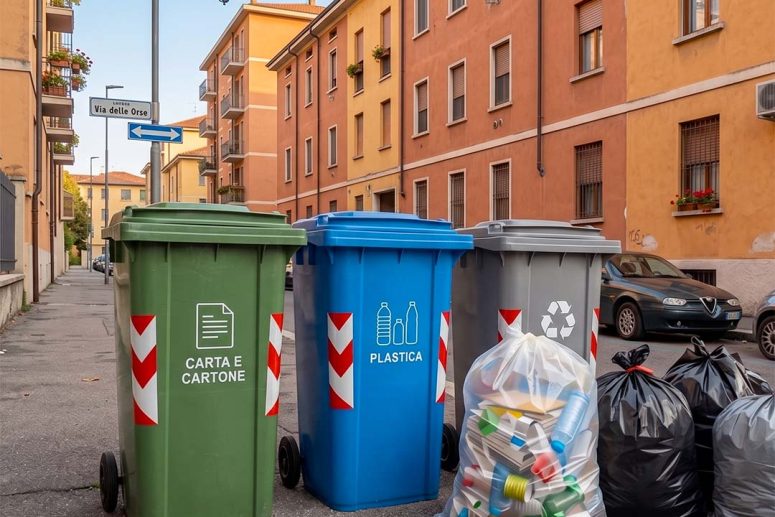
In the municipal authorities where door to door where separated collection is in force, the different types are removed directly at the user’s domicile; the organic waste is collected in biodegradable bags, contained however in solid tubs, which are necessary for reasons linked to hygiene – sun and rain make the bag decompose and it is also prone to attacks from wild animals. Glass is also contained in tubs and bins, whilst the bag is recommended for plastic, which is made of the same material and can be thrown and recycled together with the contents as well as allowing greater compacting of the material inside it. Finally, paper is collected inside re-usable plastic containers or wheelie bins.
On the other hand, what is the type of container most recommended for collecting the RUR, the type on which the pay as you throw tariff is calculated? The general waste is collected inside plastic bags or solid containers, both fitted with RFID tags for recording the consignments by the users via the antenna installed on the vehicle or the wearable device on the operator. The bags and bins have a variable capacity – usually 30/60/120 litres for bags, 40/80/120 litres for bins – and are put out once or twice a week.
the need to use different vehicles based on the type of container chosen, like compactors for the content of a bin and tank vehicles for bags;
the characteristics of the area: population density, presence of detached properties or blocks of flats, another factor influencing the collection; For example, larger sized jointly owned tubs or wheelie bins will be adopted in a big city with a lot of grouped users, whilst smaller municipalities with single family homes will have smaller bins, and so on.
When tossing the bag, the waste collector picks up from four to five bags at the same time and tosses them into the hopper together, an extremely quick operation. Emptying, on the other hand, is a single grab: the waste collection operator takes one bin at a time and empties it contents into the hopper, a more careful, but slower, operation. If, however, the process with the bag is quicker, the waste in a tub can be compacted more.
The bag is very low cost, usually 15 cents, but it must be thrown away on every use. In a municipality where the RUR is collected once a week, 52 bags are required a year, with an annual cost close to 8 euros. The bin has a much higher price, around 4 or 5 euros, but its long life – a good quality bin lasts for up to 6 or 7 years – allows the initial expense to be amortized over time. Further factors that influence the costs are the material from which the container is made and the type of RFID used.
The RFID tag for the pay as you throw metering which is put on the bag is adhesive and tied to the short life of the bag. On the other hand, the one put on the bin is solid, strong and has a lifetime similar to the container.
The distribution of bags is quicker – in fact, the users withdraw them periodically – and can also be carried out via a vending machine; for bins, it is more complex, since these must be delivered directly to the user, but less often, given their long life.
The semi-transparent bag allows any wrong consignments by the users to be checked more easily.
The bins – lined up outside the residences – guarantee greater civic decorum compared to the piles of bags put out on dustbin day, but it must be taken into account that a lot of bins are put out at the same time for grouped users.
The comparison therefore shows that there is no type of container that is absolutely the best, since the choice must take into account the different requirements of the municipality in which the pay as you throw collection is implemented.
RELATED ARTICLE
This site uses technical and profiling cookies.
You can accept, reject, or customize the cookies by clicking the desired buttons.
By closing this notice, you will continue without accepting.
By accepting, you acknowledge that your personal data may be collected for the purpose of personalizing and measuring the effectiveness of advertising.
Privacy Settings
This website uses cookies to improve your experience while you navigate through the website.
Google Analytics is a web analytics service provided by Google Ireland Limited ("Google"). Google uses the collected personal data to track and examine the usage of this website, compile reports on its activities, and share them with other Google services. Google may use your personal data to contextualize and personalize the ads of its advertising network. The data sent is collected for the purposes of personalizing the experience and statistical tracking. You can find more information on the "More information on Google's handling of personal information" page.
Place of processing: Ireland - Privacy Policy
Additional consents:
Google Tag Manager is a tag management service provided by Google Ireland Limited. You can find more information on the "More information on Google's handling of personal information" page.
Place of processing: Ireland - Privacy Policy
Ally is software, provided by Elementor Ltd, that enhances usability and optimizes digital content, making it accessible and usable for a wide range of users, including those with disabilities.
Place of processing: Israel - Privacy Policy
Cloudflare Turnstile is a SPAM protection service provided by CloudFlare Inc.
Place of processing: United States - Privacy Policy
Google reCAPTCHA is a SPAM protection service provided by Google Ireland Limited.
The use of reCAPTCHA is subject to the Google privacy policy and terms of use.
Place of processing: Ireland - Privacy Policy
YouTube is a video content visualization service provided by Google Ireland Limited. This service allows this Website to incorporate content of this kind on its pages.
This widget is set up in a way that ensures that YouTube will not store information and cookies about Users on this Website unless they play the video.
Place of processing: Ireland - Privacy Policy
Google Fonts is a service used to display font styles operated by Google Ireland Limited and serves to integrate such content into its pages.
Place of processing: Ireland - Privacy Policy
Google Maps is a maps visualization service provided by Google Ireland Limited. This service is used to incorporate content of this kind on its pages.
Place of processing: Ireland - Privacy Policy
Google OAuth is a login and identity verification system provided by Google, which allows users to access the website using their credentials linked to the Google services ecosystem.
Place of processing: United States - Privacy Policy
Clarity is a session recording and heat mapping service provided by Microsoft Corporation.
Place of processing: United States - Privacy Policy
Additional consents:

The cookie notice is hidden
A browser extension or setting seems to be hiding the banner this site uses to ask for your consent. While it stays hidden, you cannot give or change your consent.
To do so, allow this site in your ad blocker or in your browser's privacy settings, then reload the page.